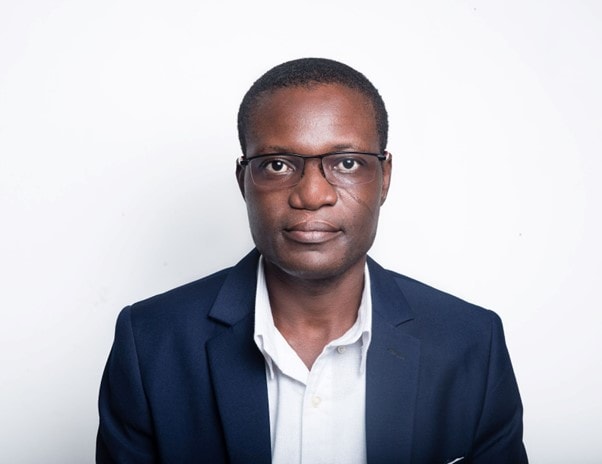
Prosper A.B. Ayande (40) is Safisana’s Impact and Partnership Manager. In this position, he plays a vital part in impact measuring and monitoring of the Safisana Solution, and establishing and maintaining good relationships with all the public and private stakeholders involved. In this interview, he talks about some of the transformations he has experienced both throughout his personal and professional life.
Impact and Partnerships Management at Safisana
"I have a passion for creating impact and supporting people and the environment "
You grew up in the far North. What was your childhood/ adulthood like?
"I come from a town called Bawku, in the Northern part of Ghana. From where we grew up, we could walk to Burkina Faso. I have three brothers and two sisters, we were a family of eight and I am the fourth born. Even though the poverty rate in the North of Ghana is quite high, our family was lucky to live comfortably. My father was a medical practitioner and therefore we were fortunate to go to a good school in our town. When I was about five years old, my dad passed away and my mom was left to take care of me and my five other siblings."
That must have been tough?
"My mom is a strong woman and taught us to stay focused, as she did when she took care of us. I believe my siblings and I have taken that as our biggest life lesson. We are all appreciative of the fact that she took care of us independently. Even up to today, me and my siblings always squabble about who will take care of my mom, we all want to show her that we are here for her. This lesson of staying focused is also reflected in our dedication to striving for the highest. We all became aware that we needed to push ourselves to get somewhere. Somehow it has almost become like a competition among the siblings. We are all aiming for the highest, and I can say it has reaped its benefits; all of us pursued higher education with the minimum of a master’s degree."
After high school, you moved all the way to the South of the country, what was this change like for you?
"When I went to Takoradi for university, to study Supply Chain Management, I noticed that there is a vast difference, the weather in the North of Ghana is more desert-like, the poverty rate is higher, and living and education standards are generally lower. Going to Takoradi was definitely an eye-opening experience. I got to expand my horizons even more when I went to the United Kingdom to take my professional exams. In 2004, I became a full member of the Chartered Institute of Purchase and Supply. I was 21 years old at that time, I was the youngest member from Ghana. So, I received a lot of job offers in the UK. I worked with Leicester City Council for two years as a Contract Analyst. After, I got hired by Middlesex University- Hendon, northwest London to be the Procurement Advisor, for which I worked for another 2 years."
What made you decide to move back to Ghana?
"When I worked in the UK, I found myself thinking about rather putting my effort and knowledge into developing Ghana. I believed I would be better off working in Ghana and making progress here. I pursued an Executive Master of Business Administration (MBA) in Project Management from the University of Ghana Business School where I specialized in Evaluation of Development Projects which is the link to my expertise in Monitoring and Evaluation.
"Coming back to Ghana was a wise choice, I am happy to live in Ghana and I am living a comfortable life. Plus, now I live close to my mom, she lives in Kumasi."
How did you eventually end up at Safisana?
"I didn't work for Safisana immediately when I came back. First off, I supported my godfather with his NGO, People's Dialogue on Human Settlement. I have a passion for creating impact and supporting people and the environment. While I worked with him, I also did independent consultancy on the side, for organizations such as Plan Ghana, WaterAid, The World Bank, Ministry of Sanitation and Water Resources, CONIWAS, and many more. Through one of those projects, I got in contact with Safisana. I remember, one day, I called my contact at Safisana to round off a project, and that was when he told me about the open vacancy of Monitoring and Evaluation Officer. I applied and here I am!"
You are the Impact and Partnership Manager, what does your job entail?
"It is a very varied job with a wide range of tasks. I am still responsible for monitoring and evaluation. We collect all kinds of data from our plant operations, projects and programs, to derive insights on operational performance and impact. It is my task to review, analyze and present these data in comprehensive visualizations for internal use to facilitate informed decision-making and achieve operational excellence, but very importantly also in external communications and impact reporting to our investors and other stakeholders."
How does Safisana assess its impact?
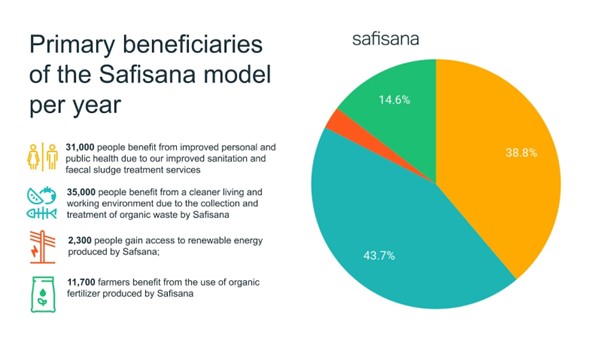
"To assess the impact of Safisana's operations in Ashaiman, we have developed a Monitoring and Evaluation framework. Within the M&E framework, we have defined a set of four key indicators related to primary operational data: volumes of faecal waste treated, volumes of organic waste treated, amount of energy produced and sold, and volumes of fertilizer produced and sold. For each of these indicators, we have developed methodologies to calculate the number of beneficiaries. For instance, we state that 31,000 people yearly benefits from improved personal health and hygiene as a result of faecal sludge treatment by Safisana. This means, we have treated the amount of waste produced by 31,000 inhabitants of Ashaiman.
The beneficiaries of the four key indicators all together result in the total number of primary beneficiaries. On average, over 80,000 people yearly directly benefit from improved health and well-being due to our products and services.
We also distinguish secondary beneficiaries. Those are people who benefit either from non-core activities such as training and awareness raising, or they benefit indirectly from our solution. For some of these indicators, we are still developing and improving calculation methodologies. Examples of the secondary category are for instance: indirect jobs created, increase of food yields and income for farmers due to use of our organic fertilizer. The more data we collect, the more impact evidence we can share with our stakeholders."
Speaking of stakeholders, what does your work as Partnership Manager entail?
"In my role as Partnership Manager, I am the key contact person for external partners in Ghana. All of my efforts are focused on establishing and maintaining strong relationships with current and future stakeholders and creating the right conditions for the expansion of our business.
"As a private solution to a public problem, Safisana Ghana works with both public and private stakeholders, ranging from the different Ministries in Ghana (Sanitation, Food and Agriculture) to the Municipal Assembly of the community of Ashaiman, where we are located. We have a Public Private Partnership (PPA) Agreement with the Assembly to treat waste generated in the municipality. As one of the first companies in Ghana, we have pursued a Power Purchase agreement with the Electricity Company of Ghana (ECG) for the off-taker of the electricity we produce and feed into the national grid. To ensure health and safety, our products and services need to meet the regulations of the Energy Commission, Environmental Protection Authority, and regulatory bodies such as the Food and Drugs Authority, the Plant Protection and Regulatory Services Department (PPRSD) and Cocoa Research Institute of Ghana (CRIG) for the certification of our premium organic fertilizer.
"On a client level, we also work with public partners such as utilities, and private partners, such as national and multinational industries. We believe that this cross-sector and cross-silo approach will serve as a flywheel effect that enable us to scale our business and grow our impact. Food processing industries such as Nestle, NutriFoods, FanMilk, Promasidor, HPW Fresh and Dry, and Blueskies are involved as waste suppliers but they are also increasingly interested in the offtake of renewable energy. These companies all have the same drive to work with us, to achieve their environmental sustainability goals: to reduce footprint, carbon emission and zero waste to landfill.
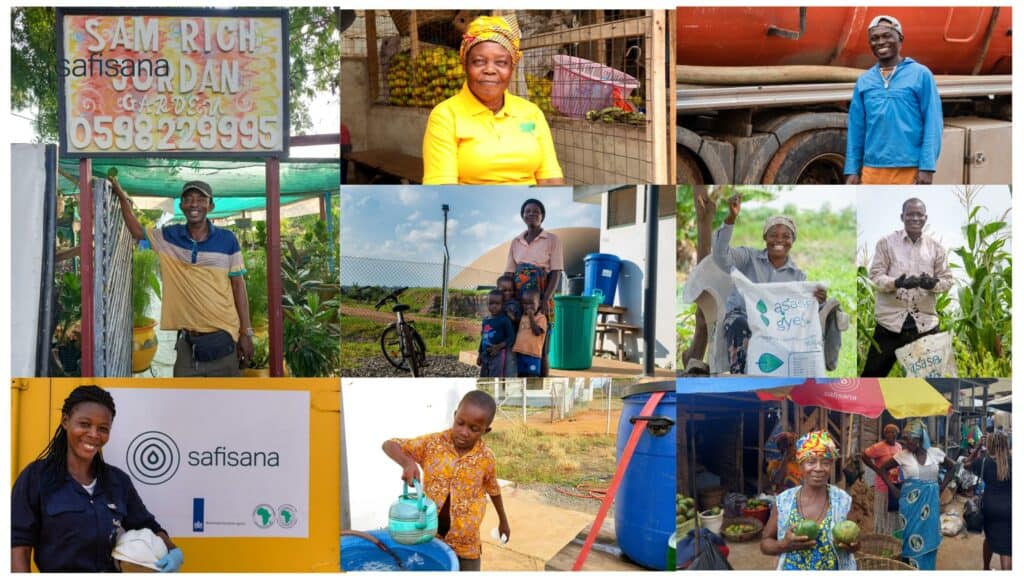
"Last but not least, we work with the people in the community such as the market queens, the toilet operators, and faecal truck drivers, in raising awareness around safe sanitation, waste recycling, and how it improves their health and wellbeing. Because we clean the market and we treat the faecal waste from the public toilets, these people experience a very direct social economic benefit from our services, as they save cost and generate more income with their business services."
What do you most enjoy in your job and what are the challenges?
"What I enjoy most about this job is seeing the impact that we make. And reporting on the number of people that are benefiting from our projects. Before I worked for Safisana, I knew about the living standards in Ashaiman. Seeing the transformation from what it used to be to what it is today gives me joy every single day.
"The biggest challenge I face with this work is that in the rapidly evolving landscape of the circular economy and bio-economy, there is often a dearth of accurate and credible data related to project outcomes, environmental impacts, and socio-economic changes. This absence of readily available data makes it difficult to apply standardized impact measurement methodologies. Therefore we often need the development of new measurement approaches from scratch."
What achievements are you most proud of?
"As mentioned before, on average, over 80,000 people benefit from the operations of the plant annually. One of the biggest impacts that Safisana has achieved has to do with environmental impact. We prevent 9,700 tonnes of faecal waste yearly from being dumped in the sea, and over 3,600 tonnes of organic waste yearly, dumped in landfills. This equals to an avoidance of 1,158 metric tonnes of greenhouse gas emissions emitted to the atmosphere. Moreover, we have significantly reduced the number of people who are in direct contact with faecal waste in Ashaiman. Which has indirectly led to a reduction in sanitation-related diseases such as cholera, dysentery, intestinal worms and typhoid.
"There is always more room for growth. I can clearly identify opportunities for growth in circular waste treatment plants like ours. Currently, we are in touch with the Ministry of Sanitation and Water Resources, as well as with the World Bank. They have implemented projects, such as the GAMA Sanitation and Water project. With this project, they have constructed toilet facilities mainly in the Greater Accra Metropolitan Area (GAMA). But constructing toilets doesn’t solve the health crisis if you keep on dumping faecal sludge in the environment. So that is where we see Safisana coming in. We see ourselves as the innovators in the industry. Offering a circular closed-loop solution to waste treatment for these poor urban areas. The collaboration with the GAMA Project will enlarge the impact that we are making currently, by a 10-fold increase."
“ Before I worked for Safisana, I knew about the living standards in Ashaiman. Seeing the transformation from what it used to be to what it is today gives me joy every single day.”